Showing posts with label #environment. Show all posts

Friday, May 01, 2026

Hanging Glacier in Himalayas (Critical Analysis)

Study Warns of Danger from Hanging Glaciers in Central Himalaya

What Are Hanging Glaciers?
✅ Hanging glaciers are small glaciers located on steep mountain slopes and valley walls
✅ They often terminate abruptly and are vulnerable to sudden break-offs, avalanches and ice collapse

Key Findings of the Study
- Researchers identified 219 hanging glaciers in the Alaknanda basin of Uttarakhand, a key headstream region of the Ganga
- These glaciers cover nearly 72 sq km with an estimated ice volume of 2.39 cubic km
- Nearly one-third of them are in a highly “unstable” condition and prone to collapse

Who Conducted the Study?
- Scientists from:
- Indian Institute of Science
- Indian Institute of Technology Bhubaneswar
- Defence Research and Development Organisation
- The study was published in the journal npj Natural Hazards

Why Are These Glaciers Becoming Dangerous?
1- The Himalayas are warming faster than the global average
2- Rapid warming has accelerated glacier retreat in the last two decades
3- Retreat of larger glaciers has destabilised tributary and hanging glaciers on mountain slopes
4- Many hanging glaciers are now in an “unstable state”, increasing the risk of avalanches

Vulnerable Regions
- The most vulnerable area is the Alaknanda Basin
- The basin ranges from 400 m to 7,800 m in elevation and is both geologically fragile and seismically active
- It contains important pilgrimage and tourism centres such as:
- Badrinath
- Kedarnath
- Mana


Possible Consequences
- Sudden collapse of hanging glaciers can trigger:
- Massive avalanches
- River blockage
- Temporary glacial lakes
- Flash floods downstream
- Avalanche debris could exceed 50 metres in some locations
- In the worst-case scenario, avalanches could affect settlements like Mana, Badrinath and Hanuman Chatti

Role of Human Activities
- Human exposure is rising due to rapid infrastructure expansion in fragile Himalayan regions
- Built-up area in vulnerable zones has increased from about 8,000 sq m in 2000 to more than 1,50,000 sq m projected by 2030
- Roads, hydropower projects, tourism and urbanisation are increasing risk

Why This Matters for India
- The affected region is the source of the Ganga and supports millions of people downstream
- The Himalayas are crucial for water security, pilgrimage, hydropower and biodiversity
- Glacier-related disasters can threaten both lives and critical infrastructure

Suggested Measures
1- Continuous monitoring of high-risk glaciers through satellites and drones
2- Use of avalanche simulation and early warning systems
3- Restrict infrastructure expansion in vulnerable zones
4- Prepare hazard maps and climate-resilient development plans
5- Focus on the most dangerous glaciers first, as full-scale monitoring of all glaciers may not be feasible

Conclusion
- The study highlights that climate change and unplanned development are making the Central Himalaya increasingly vulnerable.
- India needs a precautionary approach that combines glacier monitoring, disaster preparedness and sustainable mountain development.

Monday, April 27, 2026

Heat Dome Effect


๐Ÿ”ด Heat Dome (เคนीเคŸ เคกोเคฎ)

✔️เคตाเคฏुเคฎंเคกเคฒ เคฎें เค‰เคš्เคš เคฆเคฌाเคต (High Pressure) เค•ा เค•्เคทेเคค्เคฐ
✔️เคฏเคน เค—เคฐ्เคฎ เคนเคตा เค•ो เคœเคฎीเคจ เค•े เคชाเคธ เคซंเคธा เคฆेเคคा เคนै
✔️เคชเคฐिเคฃाเคฎ: เคฒเค—ाเคคाเคฐ เคคाเคชเคฎाเคจ เคฌเคข़เคคा เคฐเคนเคคा เคนै (เคนीเคŸเคตेเคต)

เคช्เคฐเคญाเคตिเคค เคฐाเคœ्เคฏ: เค‰เคค्เคคเคฐ เคต เคฎเคง्เคฏ เคญाเคฐเคค (เคฐाเคœเคธ्เคฅाเคจ, เคฏूเคชी, เคฎเคง्เคฏ เคช्เคฐเคฆेเคถ, เค›เคค्เคคीเคธเค—เคข़, เคฆिเคฒ्เคฒी, เคนเคฐिเคฏाเคฃा)

เค•ैเคธे เคฌเคจเคคा เคนै -
✔️เคŠเคชเคฐ เค‰เคš्เคš เคฆเคฌाเคต → เคนเคตा เคจीเคšे เค•ी เค“เคฐ เคฆเคฌเคคी เคนै
✔️เคจीเคšे เค†เคคे เคธเคฎเคฏ เคนเคตा เค”เคฐ เค—เคฐ्เคฎ (Compression Heating) เคนो เคœाเคคी เคนै
✔️เคฌाเคฆเคฒों เค•ो เคฌเคจเคจे เคธे เคฐोเค•เคคा เคนै → เคฌाเคฐिเคถ เคจเคนीं เคนोเคคी

เคช्เคฐเคญाเคต-
▪️เคคाเคชเคฎाเคจ 40°C+ เคคเค• เคชเคนुंเคš เคธเค•เคคा เคนै
▪️เคฒू (Heatwave) เค•ी เคธ्เคฅिเคคि
▪️เคฎिเคŸ्เคŸी เคต เคชौเคงों เค•ी เคจเคฎी เค–เคค्เคฎ
▪️เคฒंเคฌे เคธเคฎเคฏ เคคเค• เคธ्เคฅिเคฐ เค—เคฐ्เคฎी

Tuesday, April 04, 2023

Earth Hour (Analysis)


✅It is a global grassroots movement uniting people to take action on environmental issues and protect the planet.
It is organized by World Wildlife Fund (WWF).

✅It was started by WWF and partners as a symbolic lights-out event in Sydney in 2007.

✅It takes place on the last Saturday of March every year.
“Earth Hour” encourages people to switch off all lights for an hour, from 8:30 pm to 9:30 pm local time to promote awareness of climate change challenges and energy conservation.

✅Governments and companies also participate by turning off non-essential lights in their buildings, monuments, and landmarks to raise awareness about the impact of energy consumption on our planet.

This symbolic act, known as the ‘lights off’ moment, unites people worldwide in a show of support for the planet and serves as a reminder of the environmental issues facing us.

๐Ÿ“What is the World Wildlife Fund (WWF)?

✅It is an international non-governmental organization (NGOfounded in 1961 in Morges, Switzerland, to protect endangered species of wildlife and preserve natural habitats.

Mission: To stop the degradation of the planet’s natural environment and to build a future in which humans live in harmony with nature.

WWF works with a broad spectrum of partners, including governmentsindustry, and local communitiesto find solutions to the challenges that face our natural world.

Sunday, February 12, 2023

Darwin's Theory of Evolution (overview)


INTRODUCTION : The Theory of Evolution by Natural Selection was first formulated in Charles Darwin's book "On the Origin of Species(opens in new tab)" published in 1859. In his book, Darwin describes how organisms evolve over generations through the inheritance of physical or behavioural traits, as National Geographic explains. The theory starts with the premise that within a population, there is variation in traits, such as beak shape in one of the Galapagos finches Darwin studied. According to the theory, individuals with traits that enable them to adapt to their environments will help them survive and have more offspring, which will inherit those traits. Individuals with less adaptive traits will less frequently survive to pass them on. Over time, the traits that enable species to survive and reproduce will become more frequent in the population and the population will change, or evolve, according to BioMed Central. Through natural selection, Darwin suggested, genetically diverse species could arise from a common ancestor. 

Darwin did not know the mechanism by which traits were passed on, according to National Geographic. He did not know about genetics, the mechanism by which genes encode for certain traits and those traits are passed from one generation to the next. He also did not know about genetic mutation, which is the source of natural variation. But future research by geneticists provided the mechanism and additional evidence for evolution by natural selection.


WHAT IS NATURAL SELECTION? : Darwin chose the term "natural selection" to be in contrast with "artificial selection," in which animal breeders select for particular traits that they deem desirable. In natural selection, it's the natural environment, rather than a human being, that does the selecting.

Put simply, the theory of evolution by means of natural selection can be described as "descent with modification," said Briana Pobiner(opens in new tab), an anthropologist and educator at the Smithsonian National Museum of Natural History in Washington, D.C., who specialises in the study of human origins. The theory is sometimes described as "survival of the fittest," but that characterization can be misleading, Pobiner said. Here, "fitness" refers not to an organism's strength or athleticism but rather its ability to survive and reproduce.

Natural selection can alter a species in small ways, causing a population to change colour or size over the course of several generations, according to The Natural History Museum(opens in new tab). When this process happens over a relatively short period of time and in a species or small group of organisms, scientists call it "microevolution."
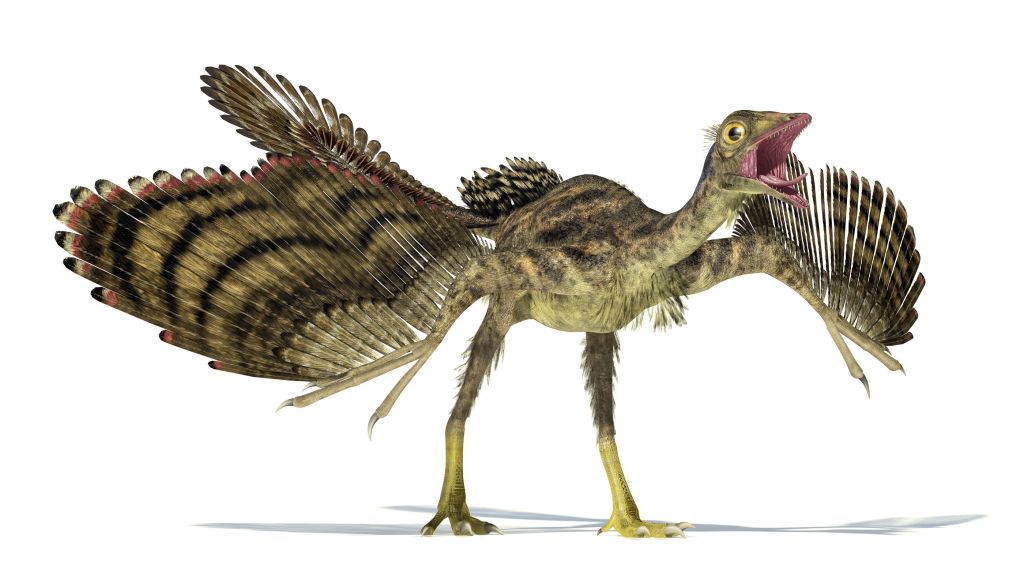


Archaeopteryx, shown here in this illustration, is considered the first bird-like dinosaur on record, dating to about 150 million years ago during the Jurassic period. (Image credit: Leonello Calvetti/Getty Images)


But when given enough time and accumulated changes, natural selection can create entirely new species, a process known as "macroevolution," according to Derek Turner and Joyce C. havstad in "The Philosophy of Macroevolution." This long-term process is what turned dinosaurs into birds, amphibious mammals (such as an animal called Indohyus) into whales and a common ancestor of apes and humans into the people, chimps and gorillas we know today. 

Darwin also described a form of natural selection that depends on an organism's success at attracting a mate — a process known as sexual selection, according to Nature Education. The colourful plumage of peacocks and the antlers of male deer are both examples of traits that evolved under this type of selection. 


HOW DID WHALES EVOLVE? : One of the best examples scientists have of natural selection is the evolution of whales. By using Darwin's theory as a guide, and understanding how natural selection works, biologists determined that the transition of early whales from land to water occurred in a series of predictable steps.

The evolution of the blowhole, for example, might have started with random genetic changes that resulted in at least one whale having its nostrils farther back on its head, according to Phys.org

The whales with this adaptation would have been better suited to a marine lifestyle, since they would not have had to completely surface to breathe. Such individuals were more successful and had more offspring. In later generations, more genetic changes occurred, moving the nose farther back on the head.

Other body parts of early whales also changed. Front legs became flippers. Back legs disappeared. Their bodies became more streamlined, and they developed tail flukes to better propel themselves through water, according to the Natural History Museum. Even though scientists could predict what early whales should look like, for a long time they lacked the fossil evidence to back up their claim. Creationists viewed this absence, not just with regard to whale evolution but more generally, as proof that evolution didn't occur, as pointed out in a Scientific American article.
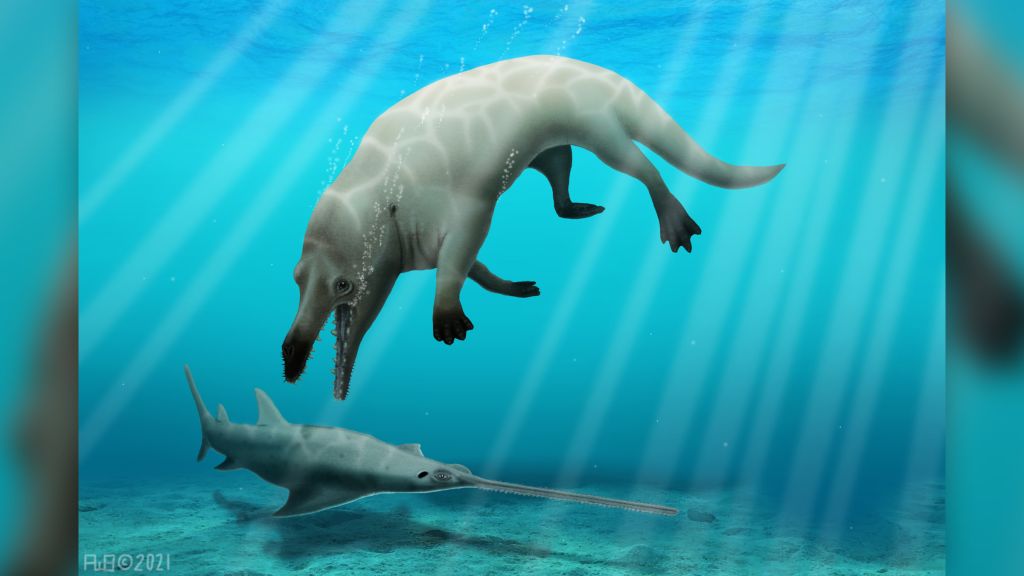


This illustration shows the semiaquatic "god of death" whale, called Phiomicetus anubis, that lived about 43 million years ago in what is now Egypt. (Image credit: Illustration by Robert W. Boessenecker)


However, since the early 1990s, scientists have found evidence from palaeontology, developmental biology and genetics to support the idea that whales evolved from land mammals. These same lines of evidence support the theory of evolution as a whole.

In the first edition of "On the Origin of Species," Darwin speculated about how natural selection could cause a land mammal to turn into a whale. As a hypothetical example, Darwin used North American black bears (Ursus americanus), which were known to catch insects by swimming in the water with their mouths open, according to the Darwin Correspondence Project.

"I can see no difficulty in a race of bears being rendered, by natural selection, more aquatic in their structure and habits, with larger and larger mouths, till a creature was produced as monstrous as a whale," he speculated.

The idea didn't go over very well with the public or with other scientists. Darwin was so embarrassed by the ridicule he received. that the swimming-bear passage was removed from later editions of the book. Scientists now know that Darwin had the right idea but the wrong animal. Instead of looking at bears, he should have been looking at cows and hippopotamuses.


OTHER THEORIES OF EVOLUTION : Darwin wasn't the first or only scientist to develop a theory of evolution. Around the same time as Darwin, British biologist Alfred Russel Wallace independently came up with the theory of evolution by natural selection, according to the Natural History Museum. However this had little impact.

"The concept of evolution as a historical event was a hot topic among biologists and geologists prior to Darwin’s book because there was so much evidence accumulating, but I suspect biological evolution hadn’t really impinged on people outside of the academic bunker," Dr. P John D. Lambshead, a retired science research leader in marine biodiversity, ecology, and evolution at The Natural History Museum, London, told All About History Magazine. "As long as science knew of no mechanism to explain how evolution happened it could be safely dismissed as a crank idea."

Meanwhile, French biologist Jean-Baptiste Lamarck proposed that an organism could pass on traits to its offspring, though he was wrong about some of the details, according to the University of California’s Museum of Paleontology.

Like Darwin, Lamarck believed that organisms adapted to their environments and passed on those adaptations. He thought organisms did this by changing their behaviour and, therefore, their bodies — like an athlete working out and getting buff — and that those changes were passed onto offspring. 


Maasai giraffes browse on leaves of a tall tree in the Maasai Mara National Reserve, Kenya. (Image credit: Anup Shah/Getty Images)

For example, Lamarck thought that giraffes originally had shorter necks but that, as trees around them grew taller, they stretched their necks to reach the tasty leaves and their offspring gradually evolved longer and longer necks. Lamarck also believed that life was somehow driven to evolve through the generations from simple to more complex forms, according to Understanding Evolution, an educational resource from the University of California Museum of Paleontology.

Though Darwin wasn't sure of the mechanism by which traits were passed on, he did not believe that evolution necessarily moved toward greater complexity, according to Understanding Evolution — rather, he believed that complexity arose through natural selection. 

A Darwinian view of giraffe evolution, according to Quanta Magazine, would be that giraffes had natural variation in their neck lengths, and that those with longer necks were better able to survive and reproduce in environments full of tall trees, so that subsequent generations had more and more long-necked giraffes. 

The main difference between the Lamarckian and Darwinian ideas of giraffe evolution is that there's nothing in the Darwinian explanation about giraffes stretching their necks and passing on an acquired characteristic.


WHAT IS MODERN EVOLUTIONARY SYNTHESIS? : According to Pobiner, Darwin did not know anything about genetics. "He observed the pattern of evolution, but he didn't really know about the mechanism," she said. That came later, with the discovery of how genes encode different biological or behavioural traits, and how genes are passed down from parents to offspring. The incorporation of genetics into Darwin's theory is known as "modern evolutionary synthesis."

The physical and behavioural changes that make natural selection possible happen at the level of DNA and genes within the gametes, the sperm or egg cells through which parents pass on genetic material to their offspring. Such changes are called mutations. "Mutations are basically the raw material on which evolution acts," Pobiner said. 

Mutations can be caused by random errors in DNA replication or repair, or by chemical or radiation damage, according to Nature Education. Usually, mutations are either harmful or neutral, but in rare instances, a mutation might prove beneficial to the organism. If so, it will become more prevalent in the next generation and spread throughout the population. 

In this way, natural selection guides the evolutionary process, preserving and adding up the beneficial mutations and rejecting the bad ones. "Mutations are random, but selection for them is not random," Pobiner said.


A molecule of DNA coiled inside a cell nucleus. (Image credit: Shutterstock)

But natural selection isn't the only mechanism by which organisms evolve, she said. For example, genes can be transferred from one population to another when organisms migrate or immigrate — a process known as gene flow. And the frequency of certain genes can also change at random, which is called genetic drift. 

The reason Lamarck's theory of evolution is generally wrong is that acquired characteristics don't affect the DNA of sperm and eggs. A giraffe's gametes, for example, aren't affected by whether it stretches its neck; they simply reflect the genes the giraffe inherited from its parents. But as Quanta reported, some aspects of evolution are Lamarckian.

For example, a Swedish study published in 2002 in the European Journal of Human Genetics found that the grandchildren of men who starved as children during a famine passed on better cardiovascular health to their grandchildren. Researchers hypothesise that although experiences such as food deprivation don't change the DNA sequences in the gametes, they may result in external modifications to DNA that turn genes "on" or "off."

Such changes, called epigenetic changes, do not modify the actual DNA sequence itself. For instance, a chemical modification called methylation can affect which genes are turned on or off. Such epigenetic changes can be passed down to offspring. In this way, a person's experiences could affect the DNA he or she passes down, analogous to the way Lamarck thought a giraffe craning its neck would affect the neck length of its offspring.


WHAT IS THE EVIDENCE FOR EVOLUTION? : The Theory of Evolution is one of the best-substantiated theories in the history of science. It is supported by evidence from a wide variety of scientific disciplines, including  genetics, which shows that different species have similarities in their DNA. 

There is also evidence supporting the Theory of Evolution in palaeontology and geology. This is through the fossil record, which shows how that species that existed in the past are different from those present today, according to Bruce S. Lieberman and Roger L. Kaesler in "Prehistoric Life: Evolution and the Fossil Record" (Wiley, 2010).

There is also evidence for Darwin's theory found in developmental biology. It has been discovered that species that seem very different as adults pass through similar stages of embryological development, suggesting a shared evolutionary past, according to the open-access textbook "Concepts of Biology." 


EVIDENCE FOR WHALE EVOLUTION FROM PALEONTOLOGY : 
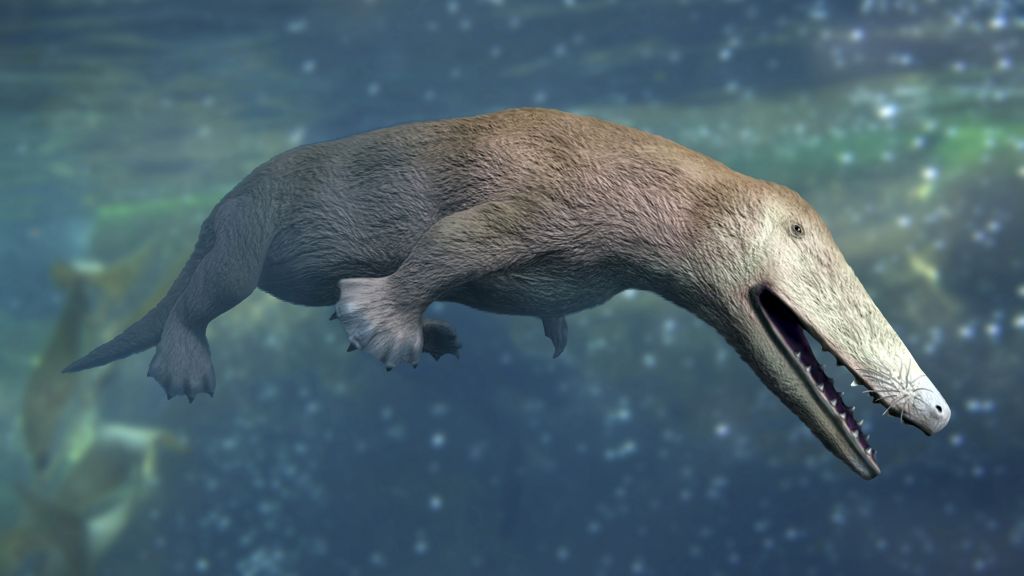
Ambulocetus natans swimming underwater. (Image credit: Nobumichi Tamura/Stocktrek Images via Getty Images)

The critical piece of evidence was discovered in 1994, when palaeontologists found the fossilised remains of Ambulocetus natans, which means "swimming-walking whale," according to a 2009 review published in the journal Evolution: Education and Outreach. Its forelimbs had fingers and small hooves, but its hind feet were enormous relative to its size. The animal was clearly adapted for swimming, but it was also capable of moving clumsily on land, much like a seal.

When it swam, the ancient creature moved like an otter, pushing back with its hind feet and undulating its spine and tail. Modern whales propel themselves through the water with powerful beats of their horizontal tail flukes, but A. natans still had a whip-like tail and had to use its legs to provide most of the propulsive force needed to move through water.

In recent years, more and more of these transitional species, or "missing links," have been discovered, lending further support to Darwin's theory. For example, in 2007, a geologist discovered the fossil of an extinct aquatic mammal, called Indohyus, that was about the size of a cat and had hooves and a long tail. 

Scientists think the animal belonged to a  group related to cetaceans such as Ambulocetus natans. This creature is considered a "missing link" between artiodactyls — a group of hoofed mammals (even-toed ungulates) that includes hippos, pigs, and cows — and whales, according to the National Science Foundation. Researchers knew that whales were related to artiodactyls, but until the discovery of this fossil, there were no known artiodactyls that shared physical characteristics with whales. After all, hippos, thought to be cetaceans' closest living relatives, are very different from whales. Indohyus, on the other hand, was an artiodactyl, indicated by the structure of its hooves and ankles, and it also had some similarities to whales, in the structure of its ears, for example.  


EVIDENCE FOR WHALE EVOLUTION FROM GENETICS & DEVELOPMENTAL BIOLOGY : 
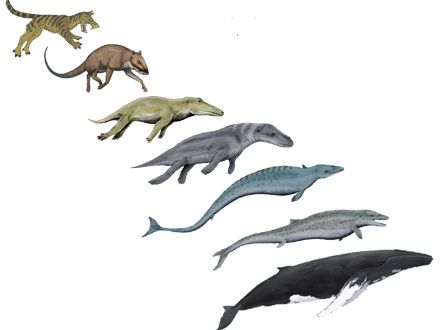

The last shore-dwelling ancestor of modern whales was Sinonyx, top left, a hyena-like animal. Over 60 million years, several transitional forms evolved: from top to bottom, Indohyus, Ambulocetus, Rodhocetus, Basilosaurus, Dorudon, and finally, the modern humpback whale. (Image credit: NOAA)

Genetic evidence also supports the idea that whales evolved from land mammals and provides information about the exact branching of the evolutionary tree. For instance, in 1999, researchers reported in the journal Proceedings of the National Academy of Sciences that according to genetic analysis of "jumping gene" sequences, which copy and paste themselves into genomes, hippos were whales' closest living relatives. Before 1985, researchers thought pigs were more closely related to whales, but this 1999 study overturned that idea, as the Associated Press reported. 

In 2019, researchers reported in the journal Science Advances about which genes within the whale genome were inactivated during the process of the creature's evolution from land mammals, as Science Friday reported. The researchers could tell that certain genes, including one involved in making saliva, had been inactivated because there are remnants of them, which the researchers call genomic fossils, in whale genomes. This indicates that whales evolved from a salivating creature.  

There's also evidence of cetacean evolution from developmental biology. Developmental biology illustrates the fact that animals that are very different as adults share similarities as embryos because they are evolutionarily related. For example, as embryos, cetaceans started to develop hind limbs, which disappear later in development, while the forelimbs remain and develop into flippers, according to the journal Evolution: Education and Outreach. This suggests that cetaceans evolved from a four-legged ancestor.


IS THE THEORY OF EVOLUTION CONTROVERSIAL? :

Despite the wealth of evidence from the fossil record, genetics and other fields of science, some people still question the theory of evolution's validity. Some politicians and religious leaders denounce the theory, invoking a higher being as a designer to explain the complex world of living things, especially humans. School boards debate whether the theory of evolution should be taught alongside other ideas, such as intelligent design or creationism.

Mainstream scientists see no controversy. "A lot of people have deep religious beliefs and also accept evolution," Pobiner said, adding, "there can be real reconciliation."

Evolution is well supported by many examples of changes in various species leading to the diversity of life seen today. "Natural selection, or to put it another way — variation, heredity, and differential fitness — is the core theory of modern biology," John Lambshead explains. "It is to biology what quantum mechanics and special relativity are to physics or the atomic model is to chemistry."


Thursday, May 05, 2022

เคœเคฒเคตाเคฏु เคชเคฐिเคตเคฐ्เคคเคจ เคชเคฐ เค†เคˆเคชीเคธीเคธी เคฐिเคชोเคฐ्เคŸ (เคธเคฎीเค•्เคทा)

@IPCC

@IPCC

@IPCC


เคตिเคถ्เคต เคฎौเคธเคฎ เคตिเคœ्เคžाเคจ เคธंเค—เค เคจ (WMO) เค”เคฐ เคธंเคฏुเค•्เคค เคฐाเคท्เคŸ्เคฐ เคชเคฐ्เคฏाเคตเคฐเคฃ เค•ाเคฐ्เคฏเค•्เคฐเคฎ (UNEP) เคฆ्เคตाเคฐा เคตเคฐ्เคท 1988  เคฎें เค†เคˆ.เคชी.เคธी.เคธी. เค•ा เค—เค เคจ เค•िเคฏा เค—เคฏा। เค‡เคธ เคชैเคจเคฒ เคฎें เคญाเคฐเคค เคธเคนिเคค 195 เคธเคฆเคธ्เคฏ เคนै। เค‡เคธเค•ा เค‰เคฆ्เคฆेเคถ्เคฏ เคธเคฐเค•ाเคฐों เค•ो เคตैเคœ्เคžाเคจिเค• เคœाเคจเค•ाเคฐी เคช्เคฐเคฆाเคจ เค•เคฐเคจा เคนै เคœिเคธเค•ा เค‰เคชเคฏोเค— เคตे เคœเคฒเคตाเคฏु เคจीเคคिเคฏों เค•े เคตिเค•ाเคธ เค•े เคฒिเคฏे เค•เคฐ เคธเค•เคคे เคนैं। เค‡เคธเค•े เคฆ्เคตाเคฐा เคชเคนเคฒी เค†เค•เคฒเคจ เคฐिเคชोเคฐ्เคŸ เคตเคฐ्เคท 1990 เคฎें เคœाเคฐी เค•ी เค—เคˆ เคฅी। เคตเคฐ्เคท 1995, 2001, 2007 เค”เคฐ 2015 เคฎें เค‡เคธเค•ी เคšाเคฐ เค…เคจ्เคฏ เคฐिเคชोเคฐ्เคŸ เคญी เคœाเคฐी เค•ी เค—เคˆ। เคฏे เคฐिเคชोเคฐ्เคŸ เค•ेเคตเคฒ เคฏเคฅाเคธंเคญเคต เคตैเคœ्เคžाเคจिเค• เคช्เคฐเคฎाเคฃों เค•े เคฎाเคง्เคฏเคฎ เคธे เคคเคฅ्เคฏाเคค्เคฎเค• เคธ्เคฅिเคคिเคฏों เค•ो เคช्เคฐเคธ्เคคुเคค เค•เคฐเคคी เคนैं, เคจ เค•ि เคฆेเคถों เคฏा เคธเคฐเค•ाเคฐों เค•ो เค•ोเคˆ เคธुเคाเคต เคฆेเคคी เคนैं।

เค‡เคธ เคช्เคฐเค•ाเคฐ, เคฏे เคฐिเคชोเคฐ्เคŸ เคœเคฒเคตाเคฏु เคชเคฐिเคตเคฐ्เคคเคจ เค•े เคช्เคฐเคคि เคตैเคถ्เคตिเค• เคช्เคฐเคคिเค•्เคฐिเคฏा เค•ा เค†เคงाเคฐ เคฌเคจเคคी เคนै। เค…ंเคคเคฐ्เคฐाเคท्เคŸ्เคฐीเคฏ เคœเคฒเคตाเคฏु เคชเคฐिเคตเคฐ्เคคเคจ เคตाเคฐ्เคคाเค“ं, เคœैเคธे- เคชेเคฐिเคธ เคธเคฎเคौเคคे เค”เคฐ เค•्เคฏोเคŸो เคช्เคฐोเคŸोเค•ॉเคฒ เค•े เคจिเคฐ्เคฎाเคฃ เคฎें เค‡เคจ เคฐिเคชोเคฐ्เคŸ्เคธ เค•ी เคฎुเค–्เคฏ เคญूเคฎिเค•ा เคฐเคนी เคนै। เคชเคฐ्เคฏाเคตเคฐเคฃ เคธुเคงाเคฐ เคชเคฐ เคจเคตीเคจเคคเคฎ เคฐिเคชोเคฐ्เคŸ เคตैเคถ्เคตिเค• เคœเคฒเคตाเคฏु เค•ाเคฐ्เคฐเคตाเคˆ เค•ो เคฒेเค•เคฐ เคเค• เค—ंเคญीเคฐ เคคเคธ्เคตीเคฐ เคชेเคถ เค•เคฐเคคी เคนै। เคฎाเคจเคตเคœเคจिเคค เคธ्เคฐोเคคों เคธे เค•ुเคฒ เคถुเคฆ्เคง เค—्เคฐीเคจเคนाเค‰เคธ เค—ैเคธ (เคœीเคเคšเคœी) เค‰เคค्เคธเคฐ्เคœ़เคจ เคฎें เคธाเคฒ 2010 เค”เคฐ 2019 เค•े เคฌीเคš เคฌเคข़ोเคคเคฐी เคœाเคฐी เคฐเคนी เคนै เคœो เค”เคฆ्เคฏोเค—िเค•ीเค•เคฐเคฃ เค•े เคชเคนเคฒे เค•े เคธเคฎเคฏ (1850) เค•े เคฌाเคฆ เคธे เคนुเคˆ เคตृเคฆ्เคงि เค•े เค…เคจुเคฐूเคช เคนै। เคตाเคธ्เคคเคต เคฎें เคธाเคฒ 2010 เคธे เคฒेเค•เคฐ 2019 เค•े เคฌीเคš เค”เคธเคค เคตाเคฐ्เคทिเค• เค—्เคฐीเคจ เคนाเค‰เคธ เค—ैเคธ เค•ा เค‰เคค्เคธเคฐ्เคœ़เคจ เคชिเค›เคฒे เค•िเคธी เคญी เคฆเคถเค• เค•े เคฎुเค•़ाเคฌเคฒे เค…เคงिเค• เคฐเคนा เคฅा, เคญเคฒे เคนी เคตिเค•ाเคธ เคฆเคฐ เคชिเค›เคฒे เคฆเคถเค• เค•ी เคคुเคฒเคจा เคฎें เค•เคฎ เคนो เค—เคˆ เคนो। เคฏเคน เคเค• เคšेเคคाเคตเคจी เค•े เคฐूเคช เคฎें เคญी เคธाเคฎเคจे เค†เคคा เคนै เค•ि เคตैเคถ्เคตिเค• เคคाเคชเคฎाเคจ เค•ो เค•เคฐीเคฌ 1.5 ° เคธेंเคŸीเค—्เคฐेเคก เคคเค• เคธीเคฎिเคค เค•เคฐเคจे เค•े เคฒिเค เค—ंเคญीเคฐ เคช्เคฐเคฏाเคธ เค•เคฐเคจे เค•ी เค†เคตเคถ्เคฏเค•เคคा เคนोเค—ी เคœिเคธเคธे เค—्เคฐीเคจ เคนाเค‰เคธ เค—ैเคธ เค‰เคค्เคธเคฐ्เคœ़เคจ เค•ा เคธ्เคคเคฐ เคธाเคฒ 2025 เคธे เคชเคนเคฒे เค•े เคœैเคธा เคจा เคนो, เค”เคฐ เคฌाเคฆ เคฎें เคธाเคฒ 2019 เค•े เคธ्เคคเคฐ เค•ी เคคुเคฒเคจा เคฎें 2030 เค•े เคญीเคคเคฐ 42 เคช्เคฐเคคिเคถเคค เค•เคฎ เคนो เคœाเค।

เคนाเคฒ เคนी เคฎें, ‘เคœเคฒเคตाเคฏु เคชเคฐिเคตเคฐ्เคคเคจ เคชเคฐ เค…ंเคคเคฐ-เคธเคฐเค•ाเคฐी เคชैเคจเคฒ’ (IPCC) เคจे ‘เคœเคฒเคตाเคฏु เคชเคฐिเคตเคฐ्เคคเคจ 2022 : เคช्เคฐเคญाเคต, เค…เคจुเค•ूเคฒเคจ เค”เคฐ เคธंเคตेเคฆเคจเคถीเคฒเคคा’ (Climate Change 2022: Impacts, Adaptation and Vulnerability) เคจाเคฎเค• เคฐिเคชोเคฐ्เคŸ เคœाเคฐी เค•ी เคนै। เคœैเคธा เค•ि เค†เคˆ.เคชी.เคธी.เคธी. เค•ो เคœเคฒเคตाเคฏु เคตैเคœ्เคžाเคจिเค•ों เค•ी เคตैเคถ्เคตिเค• เคธंเคธ्เคฅा เคฎाเคจा เคœाเคคा เคนै।


‘เคœเคฒเคตाเคฏु เคจ्เคฏाเคฏ เคเคตं เคธเคฎाเคจเคคा’ เค•ा เคฎुเคฆ्เคฆा 

  • เคฏเคน เค†เคˆ.เคชी.เคธी.เคธी. เค•ी เค›เค ीं เค†เค•เคฒเคจ เคฐिเคชोเคฐ्เคŸ เค•ा เคฆूเคธเคฐा เคญाเค— เคนै। เค‡เคธ เค†เค•เคฒเคจ เคฐिเคชोเคฐ्เคŸ เค•े เคชเคนเคฒे เคญाเค— เค•ो เค…เค—เคธ्เคค 2021 เคฎें เคœाเคฐी เค•िเคฏा เค—เคฏा เคฅा। เค‡เคธเค•ा เคคीเคธเคฐा เค”เคฐ เค…ंเคคिเคฎ เคญाเค— เค…เคช्เคฐैเคฒ 2022 เคฎें เคœाเคฐी เค•िเคฏा เคœा เคธเค•เคคा เคนै, เคœिเคธเคฎें เค•ाเคฐ्เคฌเคจ เค‰เคค्เคธเคฐ्เคœเคจ เค•ो เค•เคฎ เค•เคฐเคจे เคชเคฐ เคง्เคฏाเคจ เค•ेंเคฆ्เคฐिเคค เค•िเคฏा เคœाเคเค—ा।

  • เค‡เคธ เคฐिเคชोเคฐ्เคŸ เคฎें เคชเคนเคฒी เคฌाเคฐ เคœเคฒเคตाเคฏु เค…เคจुเค•ूเคฒเคจ เคธเคฎเคฐ्เคฅเคจ (Adaptation Support) เค•े เคฒिเคฏे 'เคœเคฒเคตाเคฏु เคจ्เคฏाเคฏ เคเคตं เคธเคฎाเคจเคคा’ (Climate Justice and Equity) เค•ो เคฎเคนเคค्เคค्เคตเคชूเคฐ्เคฃ เคคเคค्เคต เค•े เคฐूเคช เคฎें เคฎाเคจ्เคฏเคคा เคฆी เค—เคˆ เคนै। เคœैเคธा เค•ि เคญाเคฐเคค เคฒंเคฌे เคธเคฎเคฏ เคธे เคœเคฒเคตाเคฏु เคจ्เคฏाเคฏ เค•े เคฎुเคฆ्เคฆे เค•ो เคตिเคถ्เคต เคฎंเคš เคชเคฐ เค‰เค ाเคคा เคฐเคนा เคนै เค”เคฐ เคตिเค•ाเคธ เค•े เคฒिเคฏे เค‰เคชเคฒเคฌ्เคง เค•ाเคฐ्เคฌเคจ เคธ्เคชेเคธ เคฎें 'เค‰เคšिเคค เคนिเคธ्เคธेเคฆाเคฐी' เคนेเคคु เคตिเค•ाเคธเคถीเคฒ เคฆेเคถों เค•े เคจेเคคृเคค्เคตเค•เคฐ्เคคा เค•ी เคญूเคฎिเค•ा เคจिเคญाเคคा เคฐเคนा เคนै।


เคตिเคถ्เคต เคธ्เคคเคฐ เคชเคฐ เคœเคฒเคตाเคฏु เคชเคฐिเคตเคฐ्เคคเคจ เค•े เคช्เคฐเคญाเคต :


เคช्เคฐाเค•ृเคคिเค• เค†เคชเคฆाเค“ं เคฎें เคตृเคฆ्เคงि 

  • เค‡เคธ เคฐिเคชोเคฐ्เคŸ เคฎें เคœเคฒเคตाเคฏु เคชเคฐिเคตเคฐ्เคคเคจ เคœเคจिเคค เคช्เคฐเคคिเค•ूเคฒ เคช्เคฐเคญाเคตों เค•े เคชเคนเคฒे เคธे เค…เคงिเค• เค—ंเคญीเคฐ เคเคตं เคต्เคฏाเคชเค• เคนोเคจे เค•ी เคšेเคคाเคตเคจी เคœाเคฐी เค•ी เค—เคˆ เคนै। เคถोเคงเค•เคฐ्เคคाเค“ं เค•े เค…เคจुเคธाเคฐ, เคœเคฒเคตाเคฏु เคธंเค•เคŸ เคธे เคจिเคชเคŸเคจे เค•े เคฒिเคฏे ‘เค—ौเคฃ’ เคฏा ‘เคตृเคฆ्เคงिเคถीเคฒ’ (Minor or Incremental) เคช्เคฐเคคिเค•्เคฐिเคฏाเคँ เคชเคฐ्เคฏाเคช्เคค เคจเคนीं เคนोंเค—ी।

  • เคœीเคตिเคค เคช्เคฐाเคฃिเคฏों เค•े เคธाเคฅ-เคธाเคฅ เคช्เคฐाเค•ृเคคिเค• เคช्เคฐเคฃाเคฒिเคฏों (Natural Systems) เคฎें เคฌเฅเคคे เคคाเคชเคฎाเคจ เค•े เคช्เคฐเคคि เค…เคจुเค•ूเคฒ เคนोเคจे เค•ी เค•्เคทเคฎเคคा เคจिเคฐंเคคเคฐ เค•เคฎเฅ›ोเคฐ เคนोเคคी เคœा เคฐเคนी เคนै। เคฏเคน เค•्เคทเคฎเคคा เค†เคจे เคตाเคฒे เคฆเคถเค•ों เคฎें เคคाเคชเคฎाเคจ เคฎें เคตृเคฆ्เคงि เค•े เคธाเคฅ เค”เคฐ เคญी เค•เคฎ เคนो เคœाเคเค—ी।

  • เคœैเคธा เค•ि เคฒเค—เคญเค— 45% เคตैเคถ्เคตिเค• เค†เคฌाเคฆी เคœเคฒเคตाเคฏु เคชเคฐिเคตเคฐ्เคคเคจ เค•े เคช्เคฐเคคि เค…เคค्เคฏเคงिเค• เคธंเคตेเคฆเคจเคถीเคฒ เค•्เคทेเคค्เคฐों เคฎें เคจिเคตाเคธ เค•เคฐ เคฐเคนी เคนै।

  • เคฏเคฆि เคคाเคชเคฎाเคจ เคฎें เคตैเคถ्เคตिเค• เคตृเคฆ्เคงि เค•ो เคชूเคฐ्เคต-เค”เคฆ्เคฏोเค—िเค• เค•ाเคฒ เคธे 1.5°C เค•े เคญीเคคเคฐ เคฌเคจाเค เคฐเค–เคจे เค•े เคฒिเคฏे เคชเคฐ्เคฏाเคช्เคค เคช्เคฐเคฏाเคธ เค•िเคฏे เคœाเคคे เคนैं เคคो เคญी เคœเคฒเคตाเคฏु เคชเคฐिเคตเคฐ्เคคเคจ เคœเคจिเคค เค•เคˆ เค†เคชเคฆाเค“ं เค•े เค…เค—เคฒे เคฆो เคฆเคถเค•ों เค•े เคฆौเคฐाเคจ เค‰เคญเคฐเคจे เค•ी เคธंเคญाเคตเคจा เคนै। 1.5°C เคธीเคฎा เค•े เค‰เคฒ्เคฒंเค˜เคจ เค•ी เคธ्เคฅिเคคि เคฎें ‘เค…เคคिเคฐिเค•्เคค เค—ंเคญीเคฐ เคช्เคฐเคญाเคต’ (Additional Severe Impacts) เคชैเคฆा เคนोเคจे เค•ी เคธंเคญाเคตเคจा เคนै।

  • เคฏเคฆि เคตिเคถ्เคต เคธเคฎुเคฆाเคฏ เค•ाเคฐ्เคฌเคจ เค‰เคค्เคธเคฐ्เคœเคจ เค•เคŸौเคคी เค•े เคฒเค•्เคท्เคฏों เค•ो เคช्เคฐाเคช्เคค เค•เคฐ เคฒेเคคा เคนै เคคो เคญी เค‡เคธ เคธเคฆी เค•े เค…ंเคค เคคเค• เคธเคฎुเคฆ्เคฐ เค•ा เคœเคฒ เคธ्เคคเคฐ 44 เคธेเคฎी. เคธे 76 เคธेเคฎी. เคคเค• เคฌเคข़ เคœाเคเค—ा। เค•िंเคคु เค‰เคš्เคš เค‰เคค्เคธเคฐ्เคœเคจ เค•ी เคธ्เคฅिเคคि เคฎें เคฏเคฆि เค—्เคฒेเคถिเคฏเคฐ เค…เคงिเค• เคคेเคœ़ी เคธे เคชिเค˜เคฒเคคे เคนैं, เคคो เคธเคฎुเคฆ्เคฐ เค•ा เคœเคฒ เคธ्เคคเคฐ เค‡เคธ เคธเคฆी เค•े เค…ंเคค เคคเค• 2 เคฎी. เค”เคฐ เคตเคฐ्เคท 2150 เคคเค• 5 เคฎी. เคคเค• เคฌเคข़ เคธเค•เคคा เคนै।


เคธ्เคตाเคธ्เคฅ्เคฏ เคช्เคฐเคญाเคตों เค•ा เค†เค•เคฒเคจ

  • เค†เคˆ.เคชी.เคธी.เคธी. เคจे เค‡เคธ เคฐिเคชोเคฐ्เคŸ เคฎें เคชเคนเคฒी เคฌाเคฐ เคœเคฒเคตाเคฏु เคชเคฐिเคตเคฐ्เคคเคจ เค•े เคธ्เคตाเคธ्เคฅ्เคฏ เคช्เคฐเคญाเคตों เคชเคฐ เคง्เคฏाเคจ เคฆिเคฏा เคนै। เคถोเคงเค•เคฐ्เคคाเค“ं เค•े เค…เคจुเคธाเคฐ, เคœเคฒเคตाเคฏु เคชเคฐिเคตเคฐ्เคคเคจ เคธे เคตेเค•्เคŸเคฐเคœเคจिเคค เค”เคฐ เคœเคฒเคœเคจिเคค เคฌीเคฎाเคฐिเคฏों, เคœैเคธे- เคฎเคฒेเคฐिเคฏा เคเคตं เคกेंเค—ू เค•ा เค–เคคเคฐा เคฌเฅ เคฐเคนा เคนै। เค‡เคจ เคฌीเคฎाเคฐिเคฏों เค•े เคช्เคฐเคคि เคเคถिเคฏा เค•े เค‰เคชोเคท्เคฃเค•เคŸिเคฌंเคงीเคฏ เค•्เคทेเคค्เคฐ เคตिเคถेเคท เคฐूเคช เคธे เคธंเคตेเคฆเคจเคถीเคฒ เคนै। 

  • เคคाเคชเคฎाเคจ เคฎें เคตृเคฆ्เคงि เค•े เคธाเคฅ เคถ्เคตเคธเคจ เคธंเคฌंเคงी เคฌीเคฎाเคฐिเคฏों, เคธंเค•्เคฐाเคฎเค• เคฐोเค—ों, เคฎเคงुเคฎेเคน เคเคตं เคถिเคถु เคฎृเคค्เคฏु เคฆเคฐ เคฎें เคตृเคฆ्เคงि เค•ी เคธंเคญाเคตเคจा เคนै। เคนीเคŸเคตेเคต, เคฌाเคข़ เคเคตं เคธूเค–े เคœैเคธी เคšเคฐเคฎ เคฎौเคธเคฎी เค˜เคŸเคจाเค“ं เค•ी เคฌเคข़เคคी เค†เคตृเคค्เคคि เคธे เค•ुเคชोเคทเคฃ, เคเคฒเคฐ्เคœी เคธंเคฌंเคงी เคฌीเคฎाเคฐिเคฏों เค”เคฐ เคฎाเคจเคธिเค• เคตिเค•ाเคฐों เคฎें เคตृเคฆ्เคงि เคนो เคฐเคนी เคนै।


เคœเคฒ เคธंเค•เคŸ เค•ी เคšुเคจौเคคी

  • เคคाเคชเคฎाเคจ เคฎें 2°C เค•ी เคตृเคฆ्เคงि เคนोเคจे เค•ी เคธ्เคฅिเคคि เคฎें เคตिเคถ्เคต เค•ी เคฒเค—เคญเค— 300 เค•เคฐोเฅœ เค†เคฌाเคฆी เค—ंเคญीเคฐ เคœเคฒ เคธเคฎเคธ्เคฏा เคธे เค—्เคฐเคธ्เคค เคนो เคœाเคเค—ी เคœเคฌเค•ि 4°C เค•ी เคตृเคฆ्เคงि เคนोเคจे เคชเคฐ เคฏเคน เค†ँเค•เฅœा 400 เค•เคฐोเฅœ เค•ो เคชाเคฐ เค•เคฐ เคธเค•เคคा เคนै।

  • เคฐिเคชोเคฐ्เคŸ เค•ा เค…เคจुเคฎाเคจ เคนै เค•ि เคฆเค•्เคทिเคฃ เค…เคฎेเคฐिเค•ा เคฎें เคเคธे เคฆिเคจों เค•ी เคธंเค–्เคฏा เค•เคนीं เคœ्เคฏाเคฆा เคฌเฅ เคœाเคเค—ी เคœเคฌ เคฒोเค—ों เค•ो เคœเคฒ เค•ी เค•เคฎी เค•ा เคธाเคฎเคจा เค•เคฐเคจा เคชเฅœेเค—ा। เคธाเคฅ เคนी, เคฆเค•्เคทिเคฃ เคเคถिเคฏा เคฎें เคญाเคฐเคค เคœैเคธे เคฆेเคถों เค•े เคฒिเคฏे เคญी เคฏเคน เคธเคฎเคธ्เคฏा เค…เคงिเค• เค—ंเคญीเคฐ เคนोเค—ी เคœเคนाँ เคเค• เคฌเฅœी เคœเคจเคธंเค–्เคฏा เคœเคฒ เคธंเคฌंเคงी เค†เคตเคถ्เคฏเค•เคคाเค“ं เค•े เคฒिเคฏे เค—्เคฒेเคถिเคฏเคฐों เคชเคฐ เคจिเคฐ्เคญเคฐ เคนै।

  • เคฌเฅเคคे เคคाเคชเคฎाเคจ เค•े เค•ाเคฐเคฃ เค‡เคจ เค—्เคฒेเคถिเคฏเคฐों เค•े เคชिเค˜เคฒเคจे เค•ी เคฆเคฐ เคชूเคฐ्เคต เค•ी เคคुเคฒเคจा เคฎें เค•เคนीं เค…เคงिเค• เคคेเคœ เคนोเคคी เคœा เคฐเคนी เคนै, เคชเคฐिเคฃाเคฎเคธ्เคตเคฐुเคช เคœเคฒ เค•ी เค‰เคชเคฒเคฌ्เคงเคคा เคฎें เค•เคฎी เค† เคฐเคนी เคนै। 


เค•ृเคทि เคเคตं เค–ाเคฆ्เคฏ เคธंเค•เคŸ

  • เคœเคฒเคตाเคฏु เคชเคฐिเคตเคฐ्เคคเคจ เค•ा เคช्เคฐเคค्เคฏเค•्เคท เคช्เคฐเคญाเคต เค•ृเคทि เคเคตं เค–ाเคฆ्เคฏ เค‰เคค्เคชाเคฆเคจ เคชเคฐ เคญी เคชเฅœेเค—ा। เคฌเฅเคคे เคคाเคชเคฎाเคจ เค•े เค•ाเคฐเคฃ เคญाเคฐเคค เคธเคนिเคค เค…เคจेเค• เค…เคซ्เคฐीเค•ी เคฆेเคถों เคฎें เค–ाเคฆ्เคฏ เค‰เคค्เคชाเคฆเคจ เคชเคฐ เค—ंเคญीเคฐ เคช्เคฐเคญाเคต เคชเฅœ เคฐเคนा เคนै। เคนाเคฒाँเค•ि, เค•ुเค› เค‰เคš्เคš เค…เค•्เคทांเคถीเคฏ เค•्เคทेเคค्เคฐों เคฎें เค•ृเคทि เค‰เคค्เคชाเคฆเค•เคคा เคชเคฐ เคธเค•ाเคฐाเคค्เคฎเค• เคช्เคฐเคญाเคต เคญी เคฆेเค–เคจे เค•ो เคฎिเคฒा เคนै เค•िंเคคु เคฏเคน เค˜เคŸเคคी เค‰เคค्เคชाเคฆเค•เคคा เค•ी เค•्เคทเคคिเคชूเคฐ्เคคि เค•े เคฒिเคฏे เค…เคชเคฐ्เคฏाเคช्เคค เคนै।

  • เคฏเคฆि เคธเคฆी เค•े เค…ंเคค เคคเค• เคคाเคชเคฎाเคจ เคฎें 1.6°C เคธे เค•เคฎ เค•ी เคตृเคฆ्เคงि เคนोเคคी เคนै เคคो เคญी เคฒเค—เคญเค— 8% เค•ृเคทि เคญूเคฎि เค–ाเคฆ्เคฏ เค‰เคค्เคชाเคฆเคจ เค•े เคฒिเคฏे เค…เคจुเคชเคฏुเค•्เคค เคนो เคœाเคเค—ी। 

  • เคคाเคชเคฎाเคจ เคตृเคฆ्เคงि เค•ा เคช्เคฐเคญाเคต เคชเคถु เคเคตं เคฎเคค्เคธ्เคฏ เคชाเคฒเคจ เคชเคฐ เคญी เคชเฅœेเค—ा। เคเค• เค…เคจुเคฎाเคจ เค•े เค…เคจुเคธाเคฐ เค…เคซ्เคฐीเค•ा เค•े เค‰เคท्เคฃเค•เคŸिเคฌंเคงीเคฏ เค•्เคทेเคค्เคฐों เคฎें เคธเคฆी เค•े เค…ंเคค เคคเค• เคธเคฎुเคฆ्เคฐी เคฎเคค्เคธ्เคฏ เค‰เคค्เคชाเคฆเคจ เคฎें 41% เคคเค• เค•ी เค•เคฎी เคนो เคธเค•เคคी เคนै।

  • เค…เคซ्เคฐीเค•ा เคฎें เคจिเคตाเคธ เค•เคฐเคจे เคตाเคฒे เคฒเค—เคญเค— เคเค•-เคคिเคนाเคˆ เคฒोเค—ों เค•े เคช्เคฐोเคŸीเคจ เค•ा เคฎुเค–्เคฏ เคธ्เคฐोเคค เคฎเค›เคฒिเคฏाँ เคนैं। เค‡เคธเค•े เค…เคคिเคฐिเค•्เคค, เคฏเคน 1.23 เค•เคฐोเฅœ เค†เคฌाเคฆी เค•ी เค†เคœीเคตिเค•ा เค•ा เคญी เคช्เคฐเคฎुเค– เคธ्เคฐोเคค เคนै। เคฏเคฆि เคฌเฅเคคे เคคाเคชเคฎाเคจ เค•े เค•ाเคฐเคฃ เค‡เคธเค•े เค‰เคค्เคชाเคฆเคจ เคฎें เค—िเคฐाเคตเคŸ เค†เคคी เคนै เคคो เค…เคซ्เคฐीเค•ा เคœैเคธे เค•्เคทेเคค्เคฐों เคฎें เค•ुเคชोเคทเคฃ เค•े เคถिเค•ाเคฐ เคฒोเค—ों เคฎें เค•เคˆ เค—ुเคจा เคตृเคฆ्เคงि เคนोเค—ी।

  • เคญुเค–เคฎเคฐी เค•ा เคธเคฐ्เคตाเคงिเค• เคช्เคฐเคญाเคต เค…เคซ्เคฐीเค•ा, เคฆเค•्เคทिเคฃ เคเคถिเคฏा เค”เคฐ เคฎเคง्เคฏ เค…เคฎेเคฐिเค•ा เคชเคฐ เคชเฅœेเค—ा। เค…เคจुเคฎाเคจ เคนै เค•ि เคตเคฐ्เคท 2050 เคคเค• เคœเคฒเคตाเคฏु เคชเคฐिเคตเคฐ्เคคเคจ เค•े เค•ाเคฐเคฃ 18.3 เค•เคฐोเฅœ เคฒोเค— เค•ुเคชोเคทเคฃ เค•ा เคถिเค•ाเคฐ เคนोंเค—ें। 


เคญाเคฐเคค เคชเคฐ เคœเคฒเคตाเคฏु เคชเคฐिเคตเคฐ्เคคเคจ เค•ा เคช्เคฐเคญाเคต :


เค•्เคทेเคค्เคฐीเคฏ เคช्เคฐเคญाเคตों เค•ा เค†เค•เคฒเคจ

  • เคฐिเคชोเคฐ्เคŸ เคฎें เคชเคนเคฒी เคฌाเคฐ เคœเคฒเคตाเคฏु เคชเคฐिเคตเคฐ्เคคเคจ เค•े เค•्เคทेเคค्เคฐीเคฏ เคช्เคฐเคญाเคตों เค•ा เค†เค•เคฒเคจ เค•िเคฏा เค—เคฏा เคนै। เค‡เคธเคฎें เคฆुเคจिเคฏा เค”เคฐ เคญाเคฐเคค เค•े เคฌเฅœे เคถเคนเคฐों เค•े เคœोเค–िเคฎों เคเคตं เค‰เคจเค•ी เค•เคฎเคœोเคฐिเคฏों เค•ा เค†เค•เคฒเคจ เคถाเคฎिเคฒ เคนै।

  • เค‡เคธ เคฐिเคชोเคฐ्เคŸ เคฎें เคญाเคฐเคค เค•ी เคชเคนเคšाเคจ เคœเคฒเคตाเคฏु เคชเคฐिเคตเคฐ्เคคเคจ เค•े เคช्เคฐเคคि เคเค• เคธंเคตेเคฆเคจเคถीเคฒ เคนॉเคŸเคธ्เคชॉเคŸ เค•े เคฐूเคช เคฎें เค•ी เค—เคฏी เคนै, เคœिเคธเคฎें เค•เคˆ เค•्เคทेเคค्เคฐ เค”เคฐ เคฎเคนเคค्เคค्เคตเคชूเคฐ्เคฃ เคถเคนเคฐ เคœเคฒเคตाเคฏु เค†เคชเคฆा เคœเคจिเคค เค—ंเคญीเคฐ เคœोเค–िเคฎों, เคœैเคธे- เคฌाเคข़, เคธเคฎुเคฆ्เคฐ เคœเคฒ เคธ्เคคเคฐ เคฎें เคตृเคฆ्เคงि, เคฒू, เคšเค•्เคฐเคตाเคค เค†เคฆि เค•ा เคธाเคฎเคจा เค•เคฐ เคฐเคนे เคนैं।

  • เค‰เคฆाเคนเคฐเคฃ เคธ्เคตเคฐुเคช เคฎुंเคฌเคˆ เคฎें เคธเคฎुเคฆ्เคฐ เคธ्เคคเคฐ เคฎें เคตृเคฆ्เคงि เคเคตं เคฌाเคข़ เค•ा เค‰เคš्เคš เคœोเค–िเคฎ, เคœเคฌเค•ि เค…เคนเคฎเคฆाเคฌाเคฆ เคฎें ‘เค…เคฐ्เคฌเคจ เคนीเคŸ เค†เค‡เคฒैंเคก’ เค•ा เค—ंเคญीเคฐ เค–เคคเคฐा เคฌเคคाเคฏा เค—เคฏा เคนै। เค‡เคธเค•े เค…เคคिเคฐिเค•्เคค เคšेเคจ्เคจเคˆ, เคญुเคตเคจेเคถ्เคตเคฐ, เคชเคŸเคจा เค”เคฐ เคฒเค–เคจเคŠ เคธเคนिเคค เค•เคˆ เคถเคนเคฐों เคฎें เค—เคฐ्เคฎी เคเคตं เค‰เคฎเคธ เค–เคคเคฐเคจाเค• เคธ्เคคเคฐ เค•े เค•เคฐीเคฌ เคชเคนुँเคš เคฐเคนी เคนै। ‘เค…เคฐ्เคฌเคจ เคนीเคŸ เค†เค‡เคฒैंเคก’ เค‰เคธ เคถเคนเคฐी เคฏा เคฎเคนाเคจเค—เคฐीเคฏ เค•्เคทेเคค्เคฐ เค•ो เค•เคนเคคे เคนैं เคœो เคฎाเคจเคตीเคฏ เค—เคคिเคตिเคงिเคฏों เค•े เค•ाเคฐเคฃ เค…เคชเคจे เค†เคธเคชाเคธ เค•े เค—्เคฐाเคฎीเคฃ เค•्เคทेเคค्เคฐों เค•ी เคคुเคฒเคจा เคฎें เค…เคงिเค• เค—เคฐ्เคฎ เคนोเคคा เคนै।


เคธเคฎुเคฆ्เคฐ เคธ्เคคเคฐ เคฎें เคตृเคฆ्เคงि

  • เค‡เคธ เคธเคฆी เค•े เคฎเคง्เคฏ เคคเค• เคญाเคฐเคค เคฎें เคช्เคฐเคคिเคตเคฐ्เคท เคฒเค—เคญเค— 35 เคฎिเคฒिเคฏเคจ เคฒोเค— เคคเคŸीเคฏ เคฌाเคข़ เค•ा เคธाเคฎเคจा เค•เคฐ เคธเค•เคคे เคนैं। เคฏเคฆि เค•ाเคฐ्เคฌเคจ เค‰เคค्เคธเคฐ्เคœเคจ เคชเคฐ เคจिเคฏंเคค्เคฐเคฃ เคจเคนीं เคฒเค—ाเคฏा เค—เคฏा เคคो เคธเคฆी เค•े เค…ंเคค เคคเค• เคฏเคน เคธंเค–्เคฏा 45 เคธे 50 เคฎिเคฒिเคฏเคจ เคคเค• เคชเคนुँเคš เคธเค•เคคी เคนै।

  • เค†เคˆ.เคชी.เคธी.เคธी. เคจे เคšेเคคाเคตเคจी เคฆी เคนै เค•ि เค…เค•ेเคฒे เคฎुंเคฌเคˆ เค•े เคธเคฎुเคฆ्เคฐ เคธ्เคคเคฐ เคฎें เคตृเคฆ्เคงि เคธे เคตเคฐ्เคท 2050 เคคเค• 162 เค…เคฐเคฌ เคกॉเคฒเคฐ เคตाเคฐ्เคทिเค• เค•ी เค•्เคทเคคि เคนो เคธเค•เคคी เคนै।


เคตेเคŸ-เคฌเคฒ्เคฌ เคคाเคชเคฎाเคจ

  • เคตเคฐ्เคคเคฎाเคจ เคฎें เคญाเคฐเคค เคฎें เคตेเคŸ-เคฌเคฒ्เคฌ เคคाเคชเคฎाเคจ (Wet-Bulb Temperatures) เคถाเคฏเคฆ เคนी เค•เคญी 31°C เคธे เค…เคงिเค• เคนुเค† เคนै। เคฆेเคถ เค•े เค…เคงिเค•ांเคถ เคนिเคธ्เคธों เคฎें เค…เคงिเค•เคคเคฎ เคตेเคŸ-เคฌเคฒ्เคฌ เคคाเคชเคฎाเคจ 25-30°C เคนै। 

  • เค•िंเคคु เค†เค—ाเคฎी เคตเคฐ्เคทों เคฎें เค•ाเคฐ्เคฌเคจ เค‰เคค्เคธเคฐ्เคœเคจ เคฎें เค•เคŸौเคคी เค•िเคฏे เคœाเคจे เค•े เคฌाเคตเคœूเคฆ เค‰เคค्เคคเคฐी เค”เคฐ เคคเคŸीเคฏ เคญाเคฐเคค เค•े เค•เคˆ เคนिเคธ्เคธे เคธเคฆी เค•े เค…ंเคค เคฎें 31°C เคธे เค…เคงिเค• เค•े เค–เคคเคฐเคจाเค• เคตेเคŸ-เคฌเคฒ्เคฌ เคคाเคชเคฎाเคจ เคคเค• เคชเคนुँเคš เคœाเคंเค—े। 

  • เคฏเคฆि เค‰เคค्เคธเคฐ्เคœเคจ เคฎें เคตृเคฆ्เคงि เคœाเคฐी เคฐเคนเคคी เคนै, เคคो เคญाเคฐเคค เค•े เค…เคงिเค•ांเคถ เคนिเคธ्เคธों เคฎें เคตेเคŸ-เคฌเคฒ्เคฌ เคคाเคชเคฎाเคจ 35°C เค•ी เค…เคธเคนเคจीเคฏ เคธीเคฎा เคคเค• เคชเคนुँเคš เคœाเคเค—ा เคฏा เค‰เคธเคธे เค…เคงिเค• เคนो เคœाเคเค—ा।

  • เคฎเคจुเคท्เคฏ เค•ो เคœเคฌ เค—เคฐ्เคฎी เคฒเค—เคคी เคนै เคคो เคตเคน เคชเคธीเคจे เคธे เคธ्เคตเคฏं เค•ो เค ंเคกा เค•เคฐ เคฒेเคคा เคนै। เคนाเคฒाँเค•ि, เคฏเคฆि เค†เคฐ्เคฆ्เคฐเคคा เคฌเคนुเคค เค…เคงिเค• เคนो เคœाเคคी เคนै, เคคो เคชเคธीเคจा เค•ाเคฎ เคจเคนीं เค•เคฐเคคा เคนै เค”เคฐ เค…เคคि เคคाเคช เค•े เคœोเค–िเคฎ เค•ी เคธ्เคฅिเคคि เค‰เคค्เคชเคจ्เคจ เคนोเคคी เคนै। เคตेเคŸ-เคฌเคฒ्เคฌ เคคाเคชเคฎाเคจ เค•ा เค‰เคชเคฏोเค— เค—เคฐ्เคฎी เค”เคฐ เค†เคฐ्เคฆ्เคฐเคคा เคฆोเคจों เค•े เคฎाเคชเคจ เค•े เคฒिเคฏे เค•िเคฏा เคœाเคคा เคนै, เคœिเคธเคธे เคฏเคน เค…เคจुเคฎाเคจ เคฒเค—ाเคฏा เคœाเคคा เคนै เค•ि เคธ्เคฅिเคคिเคฏाँ เคฎเคจुเคท्เคฏों เค•े เคฒिเค เคธुเคฐเค•्เคทिเคค เคนैं เคฏा เคจเคนीं। เคตेเคŸ-เคฌเคฒ्เคฌ เคคाเคชเคฎाเคจ เค•ी เค‰เคš्เคšเคคเคฎ เคธीเคฎा เคธाเคฎाเคจ्เคฏเคคः 35°C เคฎाเคจी เคœाเคคी เคนै।


เค•ृเคทि เค‰เคค्เคชाเคฆเคจ เคฎें เค•เคฎी

  • เคœเคฒเคตाเคฏु เคชเคฐिเคตเคฐ्เคคเคจ เคธे เคฆेเคถ เค•े เค–ाเคฆ्เคฏाเคจ्เคจ เค‰เคค्เคชाเคฆเคจ เคชเคฐ เค—ंเคญीเคฐ เคจเค•ाเคฐाเคค्เคฎเค• เคช्เคฐเคญाเคต เคชเฅœเคจे เค•ी เคšेเคคाเคตเคจी เคฆी เค—เคˆ เคนै। เคฏเคฆि เคชूเคฐ्เคต-เค”เคฆ्เคฏोเค—िเค• เคธ्เคคเคฐ เคธे เคตैเคถ्เคตिเค• เคคाเคชเคจ เคฎें 1°C  เคธे 4°C เคคเค• เคตृเคฆ्เคงि เคนोเคคी เคนै เคคो เคญाเคฐเคค เคฎें เคšाเคตเคฒ เค•ा เค‰เคค्เคชाเคฆเคจ 10% เค•े เคธ्เคฅाเคจ เคชเคฐ 30% เคคเค• เค˜เคŸ เคธเค•เคคा เคนै। เค‡เคธเค•े เค…เคคिเคฐिเค•्เคค เคฎเค•्เค•े เค•ा เค‰เคค्เคชाเคฆเคจ 25% เค•ी เคคुเคฒเคจा เคฎें 70% เคคเค• เค•เคฎ เคนो เคœाเคเค—ा।


เค‡เคธ เคฐिเคชोเคฐ्เคŸ เคฎें เค†เคˆ.เคชी.เคธी.เคธी. เคจे เคœเคฒเคตाเคฏु เคชเคฐिเคตเคฐ्เคคเคจ เค•े เค—ंเคญीเคฐ เคจเค•ाเคฐाเคค्เคฎเค• เคช्เคฐเคญाเคตों เค•ा เค‰เคฒ्เคฒेเค– เค•िเคฏा เคนै। เคญाเคฐเคค เค•ा เคตिเคถ्เคตाเคธ เคนै เค•ि เคœเคฒเคตाเคฏु เคชเคฐिเคตเคฐ्เคคเคจ เคเค• เคตैเคถ्เคตिเค• เคธाเคฎूเคนिเค• เค•ाเคฐ्เคฐเคตाเคˆ เคธเคฎเคธ्เคฏा (Global Collective Action Problem) เคนै เคœिเคธเค•ा เคธเคฎाเคงाเคจ เค•ेเคตเคฒ เค…ंเคคเคฐ्เคฐाเคท्เคŸ्เคฐीเคฏ เคธเคนเคฏोเค— เค”เคฐ เคฌเคนुเคชเค•्เคทเคตाเคฆ (Multilateralism) เคธे เคนी เคธंเคญเคต เคนै।

เค†เคˆ.เคชी.เคธी.เคธी. เค•ी เค›เค ी เคฎूเคฒ्เคฏांเค•เคจ เคฐिเคชोเคฐ्เคŸ เคฎें เคตिเคถ्เคต เคธเคฎुเคฆाเคฏ เค•ो เคฏเคน เคšेเคคाเคตเคจी เคœाเคฐी เค•ी เค—เคˆ เคนै เค•ि 2°C เค•ा เคฒเค•्เคท्เคฏ เคตिเคจाเคถเค•ाเคฐी เคนो เคธเค•เคคा เคนै। เคตिเคถ्เคต เค•ो เคธाเคฎूเคนिเค• เคฐूเคช เคธे เคคाเคชเคฎाเคจ เคตृเคฆ्เคงि เค•ो 1.5°C เค•े เคญीเคคเคฐ เคฐเค–เคจे เค•े เคฒिเคฏे เค”เคฐ เค…เคงिเค• เคฎเคนเคค्เคตाเค•ांเค•्เคทी เค•ाเคฐ्เคฐเคตाเคˆ เค•ी เคคीเคต्เคฐ เค†เคตเคถ्เคฏเค•เคคा เคนै। 

Monday, April 25, 2022

The Inherent Benefits of Agroforestry (Critical Analysis)

                     @propopulus_eu (Twitter)

Agroforestry is a land use system that integrates trees, crops and animals in a way that is scientifically sound. It integrates trees and scrubs on formland and rural landscape to enhance productivity, profitability, diversity and Ecosystem sustainability.
Significance
economic value - it meets almost half of the country's fuelwood needs, about two-third of the small Timber demand, 70-80% of the plywood requirement, 60% of the raw material for the paper pulp industry and 9-11% of the green fodder needs. tree products and tree services also contribute rebustly to rural livelihoods. Fruit, fodder, fuel, Fibres, fertiliser and timber add to food and nutritional security, income generation and work as insurance against crop failure.
Carbon sequestration - Agroforestry is tree-based farming is an established nature based activity that can aid carbon neutral growth. It enhances trees' cover outside forests, works as a surrogate for natural forest sequestering carbon, keeps the pressure off natural forests, and helps increase farmer's income.
Lower consumption of fertilisers - Nitrogen fixing trees grown in Agroforestry systems are capable of fixing about 50-100 kg nitrogen per hectare per year - one of the most promising components of the Agroforestry system. The leaf litter after decompositions forms humus, releases nutrients and improves various soil properties, it also reduces the fertiliser needs. Due to lower requirement of chemical fertilisers Agroforestry can supplement organic farming.
Global climate goals - Agroforestry can also help India meet its International obligations on - Climate creating an additional carbon sink of 2.5-3 billion tons of carbon dioxide equivalent through additional forest and tree cover by 2030 and net zero by 2070. Desertification achieved 26 million hectare of land degradation neutrality by 2030, thus meeting 9 of the 17 sustainable development goals.
Ecology friendly - use of lesser Chemicals will also help in mitigating anthropogenic effects on climate. Agroforestry helps in erosion control and water retention, nutrients recycling, carbon storage, biodiversity Preservation and cleaner air and helps communities withstand extreme weather events.

India's response to Agroforestry :
In 2014, India became the first country to adopt an Agroforestry policy - National Agroforestry policy (NAP) - to promote employment, productivity and environmental conservation.
In 2016, NAP was launched with nearly 1000 crore to transform Agroforestry into a national effect with the tagline: "Har medh par ped" (trees on every field boundary).
In the 22-23 Union budget, the finance Minister of India announced that the government of India would promote Agroforestry.

Issues in adopting Agroforestry :
Lack of information among farmers, Agroforestry has not become a movement it should have. For a long time the subject fell between the cracks of agriculture and Forestry with no ownership by either sector. Most of the farmers are small and marginal, having small fields (less than two hectare). In this area it is economically and spatially Agroforestry is unviable.

How to promote Agroforestry :
Cooperative, self-help groups, farmer-producer Organisations(FPOs) - must be promoted for building capacities to foster the expansion of three based farming and value chain development. It is possible to target at least 10% of the formland to be covered by trees. Policymakers should incorporate Agroforestry in all policies relating to land use and natural resource management and encourage government investments in Agroforestry related infrastructure and in the establishment of Sustainable Enterprises. Scientists and researchers can develop location specific tree based technologies that complement the crop and livestock systems for sustainable livelihoods, factor in gender concern, and incorporate the feedback from the local communities.

Saturday, April 23, 2022

เคŸ्เคฐॉเคชिเค•เคฒ (เค‰เคท्เคฃเค•เคŸिเคฌंเคงीเคฏ) เคœंเค—เคฒों เค•ा เคธंเคฐเค•्เคทเคฃ (เคธเคฎीเค•्เคทा)

Aerial view of peatland forest at Lokolama/Penzele around Mbandaka, ร‰quateur province, DRC @Greenpeace

เค†เคœ เค•े เคธเคฎाเคœ เค•ी เคจैเคคिเค• เคœिเคฎ्เคฎेเคฆाเคฐी เคนै เค•ि เคชเคฐ्เคฏाเคตเคฐเคฃ เค•े เคตिเคญिเคจ्เคจ เคชเคนเคฒुเค“ं เคชเคฐ เคตिเคšाเคฐ เคตिเคฎเคฐ्เคถ เค•เคฐเค•े เค‰เคธे เคธंเคฐเค•्เคทเคฃ เคช्เคฐเคฆाเคจ เค•เคฐें। เคชเคฐ्เคฏाเคตเคฐเคฃ เค•े เคตिเคญिเคจ्เคจ เคชเคนเคฒुเค“ं เคฎें เคธे เคเค• เคนै เคŸ्เคฐॉเคชिเค•เคฒ (เค‰เคท्เคฃเค•เคŸिเคฌंเคงीเคฏ) เคœंเค—เคฒों เค•ा เคธंเคฐเค•्เคทเคฃ, 

เคนเคฎाเคฐे เคœंเค—เคฒ เคœो เคชเคฐोเค•्เคท เคฐूเคช เคธे เค•ाเคฐ्เคฌเคจ เค•ा เค…เคตเคถोเคทเคฃ เค•เคฐเคคे เคนै เคœिเคจเคฎे เคŸ्เคฐॉเคชिเค•เคฒ เคœंเค—เคฒ เคฎुเค–्เคฏ เคนै,เค•ा เคธंเคฐเค•्เคทเคฃ เคช्เคฐเคฎुเค–เคคा เค•ी เคตिเคทเคฏเคตเคธ्เคคु เคนै। เคตिเคญिเคจ्เคจ เคตिเคถ्เคตเคตिเคฆ्เคฏाเคฒเคฏों เค•े เคถोเคงों เคฎें เค‡เคธ เคฌाเคค เค•ो เคช्เคฐเคฎुเค–เคคा เคฆी เคนै เค•ि เค•ाเคฐ्เคฌเคจ เค…เคตเคถोเคทเคฃ เค•ी เค•्เคทเคฎเคคा เค•ा เคน्เคฐाเคธ เคนोเคจा เคฎाเคจเคตीเคฏ เคฎूเคฒ्เคฏों เค•ी เคจैเคคिเค•เคคा เค•े เคน्เคฐाเคธ เค•ो เคฆเคฐ्เคถाเคคा เคนै। เคฎाเคจเคตीเคฏ เค—เคคिเคตिเคงिเคฏों เค•े เค•ाเคฐเคฃ เค—्เคฐीเคจเคนाเค‰เคธ เค—ैเคธ เค•ी เคฎाเคค्เคฐा เคฎें เคญी เคฒเค—ाเคคाเคฐ เคตृเคฆ्เคงि เคนो เคฐเคนी เคนै।เคเคธे เคฎें เคงเคฐเคคी เค•ो เคฌเคšाเคจे เค•े เคฒिเค เคŸ्เคฐॉเคชिเค•เคฒ เคœंเค—เคฒों เค•ा เคธंเคฐเค•्เคทเคฃ เคฌेเคนเคฆ เคœเคฐूเคฐी เคนो เคœाเคคा เคนै เค‡เคธเคธे เคจ เค•ेเคตเคฒ เค•ाเคฐ्เคฌเคจ เค•ी เคฎाเคค्เคฐा เคจिเคฏंเคค्เคฐเคฃ เคฎें เคฐเคนेเค—ी ,เคฌเคฒ्เค•ि เคคाเคชเคฎाเคจ เคตृเคฆ्เคงि เคฎें เคญी เค•เคฎी เค†เคเค—ी।

เคœंเค—เคฒों เค•ी เค•เคŸाเคˆ เคธे เคจुเค•เคธाเคจ:เคตเคจों เค•ो เค•เคŸाเคˆ เคธे เคฌเคšाเคจे เคธे เค†เคธ - เคชाเคธ เค•े เค•्เคทेเคค्เคฐों เคฎें เค‡เคธเค•े เคคाเคค्เค•ाเคฒिเค• เค…เคธเคฐ (เค•ाเคฐ्เคฌเคจ เค•ी เคฎाเคค्เคฐा เคฎें เค•เคฎी, เคคाเคชเคฎाเคจ เคฎें เค…ंเคคเคฐ, เคฎौเคธเคฎी เคตिเคธंเค—เคคिเคฏों เคฎें เค•เคฎी) เคœเคฐूเคฐ เคจเคœ़เคฐ เค†เค เคนै। เค‡เคธเค•ा เค‰เคฆाเคนเคฐเคฃ เค…เคฎेเคœ़เคจ เคนै เคœिเคธเค•े เคชเคฐिเคฃाเคฎ เคธ्เคตเคฐूเคช เคชूเคฐे เค…เคฎेเคœ़เคจ เคฌेเคธिเคจ เคฎें เค•ुเคฒ เคฌाเคฏोเคฎाเคธ เค•ा เฅซ.เฅง เคช्เคฐเคคिเคถเคค เค…เคคिเคฐिเค•्เคค เคจुเค•เคธाเคจ เคนुเค† เคนै। เคเคธे เคนी เค•ांเค—ो เคฌेเคธिเคจ เคฎें เคœंเค—เคฒ เค•ी เค•เคŸाเคˆ เคธे เฅฉ.เฅฎ เคช्เคฐเคคिเคถเคค เค…เคคिเคฐिเค•्เคค เคฌाเคฏोเคฎाเคธ เค•ा เคจुเค•เคธाเคจ เคนुเค†। เคŸ्เคฐॉเคชिเค•เคฒ เคตाเคจ เค…เคชเคจे เคญूเคฎिเค—เคค เคฌाเคฏोเคฎाเคธ เคฎें เคฒเค—เคญเค— 200 เคชेเคŸाเค—्เคฐाเคฎ (เคเค• เคชेเคŸाเค—्เคฐाเคฎ เคเค• เคŸ्เคฐिเคฒिเคฏเคจ เค•िเคฒोเค—्เคฐाเคฎ เค•े เคฌเคฐाเคฌเคฐ เคนोเคคा เคนै।) เค•ाเคฐ्เคฌเคจ เคœเคฎा เค•เคฐเคคे เคนै। 2010 เคธे เคตเคจों เค•ी เค•เคŸाเคˆ เคนเคฐ เคธाเคฒ เค‰เคธ เค•ाเคฐ्เคฌเคจ เค•ा เคฒเค—เคญเค— เคเค• เคชेเคŸाเค—्เคฐाเคฎ เคนเคŸा เคฐเคนी เคนै। เคฆूเคธเคฐे เคถเคฌ्เคฆों เคฎें เค•เคนें เคคो เค‡เคจเค•ी เค•เคŸाเคˆ เคธे เค•ाเคฐ्เคฌเคจ เค•े เคœเคฎा เคนोเคจे เคฎें เค•เคฎी เคธा เคฐเคนी เคนै เค”เคฐ เคตाเคคाเคตเคฐเคฃ เคฎें เค•ाเคฐ्เคฌเคจ เค•ी เคฎाเคค्เคฐा เคฌเคข़ เคฐเคนी เคนै।

เค…เคคः เคฏเคน เค•เคนा เคœा เคธเค•เคคा เคนै เค•ी เคœंเค—เคฒों เค•ी เค•เคŸाเคˆ เคธे เค†เคธ เคชाเคธ เค•े เค•्เคทेเคค्เคฐों เคชเคฐ เคนเคตा,เคคाเคชเคฎाเคจ เค”เคฐ เคตเคฐ्เคทा เคชเคฐ เคจिเคถ्เคšिเคค เคฐूเคช เคธे เคช्เคฐเคญाเคต เคชเคก़เคคा เคนै เคœो เค•ाเคฐ्เคฌเคจ เค•ी เคฎाเคค्เคฐा เค•ो เคญी เคฌเคข़ाเคคा เคนै।